Book a call with our dedicated team who will be able to answer all of your questions, and help you become part of the Mayfield® team.

Published February 10, 2026
Mayfield® Hotels: How Franchise Value Extraction Is Slowing Midscale Travel
While luxury and upper‑upscale hotels are expected to grow revenue in 2026 (2% for luxury and 1–1.5% for upper-upscale), USA midscale hotels show a segment left behind. According to CoStar and Truist research, USA RevPAR (revenue per available room) in 2026 is expected to remain 6.8% below 2019 levels. Despite 25% cumulative inflation, USA 2019-2024 midscale average room rates remain unchanged at $90-94.
On the surface, travel slowdowns appear to be caused by slowing demand, inflation, wages, tariffs and operating costs.
Mayfield® Hotels maintains that a hidden cause of the travel slowdown in the midscale hotel sector is value extraction from local communities, an industrialised practice by publicly traded major hotel franchise chains. Through widescale value extraction, publicly traded hotel chains have industrialised 70% of the USA hotel market, over 20,000 small business owned hotels, into an assembly line of standardized rooms.
Value extraction is institutionalized by brand mandates and required centralized purchasing, shifting hotel investment away from local vendors to chain-controlled suppliers.
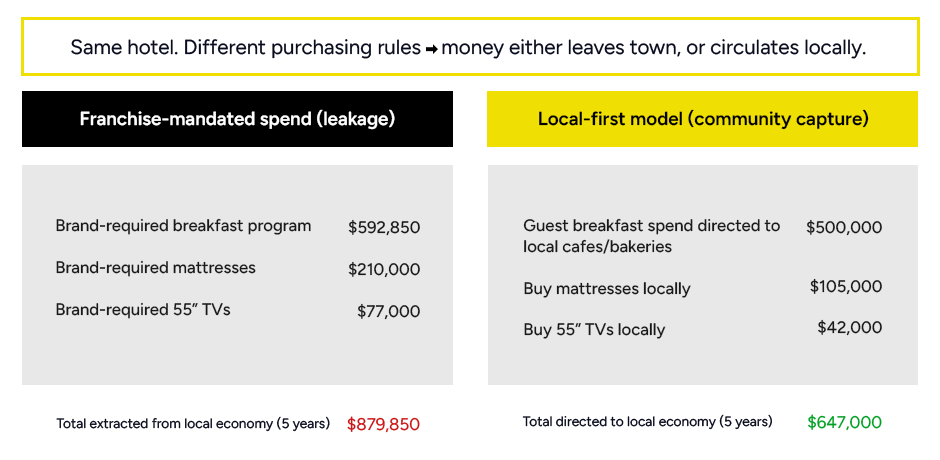
A 70 room midscale USA franchise hotel, operating at @ 60% occupancy, $90 average room rate is required to provide the chain’s branded breakfast. The hotel will generate $1,379,000 per yr in room revenue. At a breakfast cost of $7.73 per occupied room night, the total cost for the owner to provide this branded breakfast is $118,570 PY, 8.6% of total annual revenue.
Every five years, the chain requires new brand-standard mattresses from an approved vendor; for this hotel, that comes to 35 King mattresses at $2,000 each, and 70 double mattresses at $2,000 each for a total of $210,000.
The chain will require a certain model of 55” flat screen TV, purchased via the chain brand store at $1100 each, for a total of $77,000.
Instead of spending $118,000 per year on a branded breakfast, the hotel could partner with a nearby independent restaurant or bakery to provide local flavor and support the local economy. Instead of purchasing TVs and mattresses from the corporate brand store, they could be purchased from local small businesses.
Every dollar that leaves a town in franchise fees, mandatory purchasing, loyalty program fees is a dollar not reinvested in the community. And rather than contributing value for franchised small business owners, the result is a value drain — a hollowing out of local economies under the weight of industrialized franchising.
It’s not partnership — it’s strip-mining of communities.
In an American town of 4,000, a hotel is one of the few businesses that brings in outside dollars. Steering guest breakfasts and meals to local restaurants builds steady year-round revenue and grows local jobs. Purchasing hotel mattresses and TVs from local merchants turns into local payroll, local purchases, and taxable sales, which fund core community needs like public safety, hospitals, streets, schools and public services.
Not only does the local-first model keep more money circulating locally, local-first reduces costs for the hotel owner, which means savings can be passed along to an increased number of hotel guests.
With transparent knowledge of mainstream franchise practices, hotel owners have a choice: accept the traditional system, or embrace a local-first model that improves the hotel’s profitability and builds a stronger year-round local economy.
5-Year Value Extraction vs Local-First Investment
(Assumptions: 70 rooms / 60% occupancy / $90 ADR / 5-year revenue: $6,895,000
About Mayfield® Hotels:
Mayfield® Hotels is a global collection of over 100 independent midscale hotels co-founded by Melissa and Thomas Magnuson of Magnuson Hotels.
For more information:
info@mayfieldhotels.com
www.mayfieldhotels.com
Ready to learn more?